
Menopause Insomnia: Why You Wake Up at 3 AM (And How to Finally Sleep Again)

Updated: Aug 31
Menopause insomnia is one of the most frustrating things nobody warns you about. You expect the hot flashes, maybe the mood shifts - but nobody really tells you that you'll suddenly be wide awake at 3 AM with a racing mind and absolutely no idea why.
If you're going through perimenopause or menopause and sleep has become a nightmare (pun intended), I want you to know: this isn't in your head, and you are not alone. There's real biology behind it - hormones, cortisol, night sweats, blood sugar - and once you understand what's actually happening, you can start doing something about it.

Table of Contents
What Is Menopause Insomnia?
Menopause insomnia(1) isn't just tossing and turning or taking a while to fall asleep. It has a very specific, recognizable pattern - and if you've experienced it, you know exactly what I mean.
It usually looks something like this: you fall asleep without much trouble, but then you're jolted awake at 2 or 3 AM, completely alert, with your brain already running through your to-do list. You lie there for what feels like forever, willing yourself back to sleep, and it just won't happen. By the time morning comes, you're exhausted - and you have to do it all over again.
That cycle of falling asleep easily but waking mid-sleep, a racing mind at 3 AM, that strange "tired but wired" feeling, struggling to fall back asleep for hours — it's incredibly common during perimenopause and menopause. And the good news is, it has real biological causes that you can actually work with.

Want a simple way to better understand your menopause symptoms? Download my FREE "7-Day Menopause Reset" Menopause Tracker to track your symptoms, sleep, energy, mood, and daily habits—all in one easy place.
Why You Keep Waking Up at 3 AM
Here's the thing that helped me most when I first started researching this: there's a reason it's often the same time every night.
In the early morning hours - around 2 to 3 AM - it's designed to release a small amount of cortisol to gently start preparing you for waking. Think of it as your body's internal alarm system warming up.
During menopause, though, that system can get a little overactive.
With lower estrogen and progesterone (which normally help keep things balanced and calm), that early cortisol surge can hit too hard and too fast.
Instead of a gentle nudge toward waking up a few hours from now, your body essentially flips a switch. Suddenly you're awake. Alert. Sometimes anxious. And going back to sleep feels nearly impossible.
Several things are working together to pull you out of sleep:
Hormonal shifts, especially declining estrogen and progesterone
A cortisol spike that comes on too strong
Blood sugar dips that trigger your body's stress response
Temperature changes - even subtle ones - from night sweats
A nervous system that's become more reactive to stress signals
Once you see it as a physiological pattern rather than something random or broken, it actually starts to feel more manageable. Because if there's a reason, there's something you can do about it.
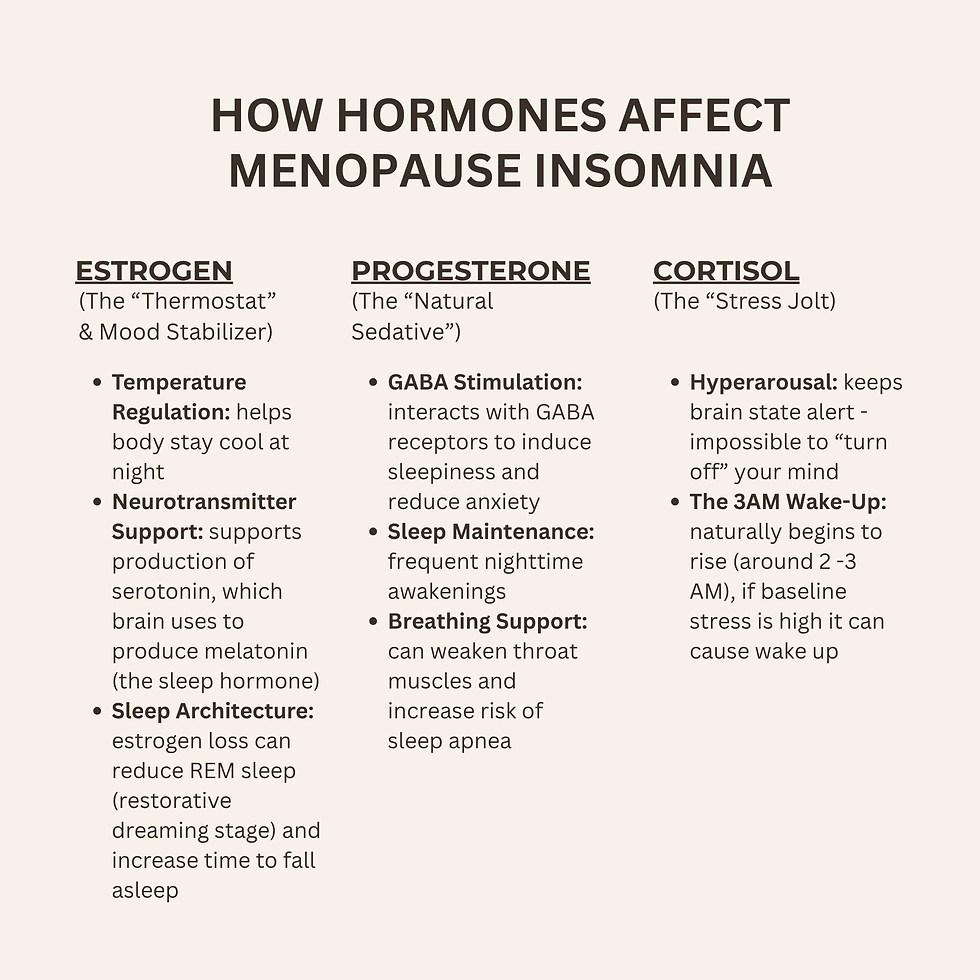
The Hormone Connection (Estrogen, Progesterone, Cortisol)
I used to brush off "it's just hormones" as a vague non-answer.
But when you actually understand what those hormones do and what happens when they drop, it makes everything click.
Estrogen Decline
Estrogen(2) does a lot more than most of us realize - it's not just a reproductive hormone. It helps regulate your sleep-wake cycle, keeps your body temperature stable, and supports serotonin production (that's the brain chemical that helps you feel calm and even-keeled).
When estrogen starts to decline, you might notice your sleep becoming lighter and more fragmented - like you're never fully "out." Small things that never used to wake you suddenly do. Your mood can feel more reactive and sensitive than usual.
None of that is weakness or anxiety - it's your brain genuinely adjusting to less hormonal support.
Progesterone Decline
f estrogen helps with the rhythm of sleep, progesterone(3) is what makes sleep feel deep and restful.
It's often called the "calming" hormone because it genuinely does quiet the nervous system.
As progesterone declines, a lot of women describe feeling like they can't fully switch off - tired but wired, unable to sink into the deep, restorative sleep they need.
You might wake up multiple times for no clear reason, or wake once and just stay awake. It's one of the most maddening parts of this whole transition.
Cortisol Dysregulation
Then there’s cortisol - your main stress hormone(4)
Ideally, it follows a predictable rhythm: low at night so you can sleep deeply, then rising naturally in the morning to help you feel alert and ready. During menopause, that rhythm can go sideways.
Your body starts running "alert mode" at the wrong times - staying activated at night and leaving you groggy in the morning.
The classic sign of this? Waking up at 3 or 4 AM feeling completely, frustratingly awake - not because anything woke you, but because your body decided it was time.
When you look at these three together, so much of the menopause sleep struggle starts to make sense. It's not random, and it's not just stress. It's a whole-system shift.
How Stress and Cortisol Spike at Night
Here's something that surprised me when I first learned it: one of the triggers for that cortisol spike in the middle of the night is your blood sugar dropping.
While you sleep, your body is quietly running internal checks. If your blood sugar dips too low, it goes into protection mode and releases cortisol to bring levels back up.
The problem?
Cortisol doesn't just fix your blood sugar - it also wakes you up.
And once you're awake, your brain jumps straight in. Suddenly you're thinking about that email you forgot to send, the thing your coworker said, everything on your plate tomorrow.
The physical trigger (cortisol) and the mental spiral (racing thoughts) feed each other, and you can be stuck for hours.
So if you wake up feeling oddly alert - not groggy, not half asleep, but genuinely awake - that's often your body doing exactly this. It's not overthinking. It's physiology. Your body is trying to help you; it's just got the timing all wrong.
Night Sweats and Temperature Dysregulation
You don't have to be waking up soaked in sweat for temperature to be messing with your sleep.
Sometimes the disruptions are subtle - just enough to pull you out of the deeper, more restorative stages of sleep without you fully realizing it.
Estrogen plays a key role in regulating your body's internal thermostat.
When levels drop, that thermostat becomes hypersensitive. You might feel suddenly too warm even when the room hasn't changed, find yourself kicking off the covers and then pulling them back an hour later, or wake up briefly so many times throughout the night that you barely remember any individual waking.
These are sometimes called micro-wakeups, and they can fragment your sleep significantly even when you feel like you "slept through the night." The result is that dragging, foggy exhaustion that feels so disproportionate to how much time you spent in bed.
Blood Sugar Drops at Night
This is probably the most underrated piece of the menopause insomnia puzzle, and it took me a while to connect it.
If you tend to eat light at night, skip protein, undereat during the day, or go long stretches without food, your blood sugar can drop significantly while you sleep.
Your body registers this as a problem that needs fixing fast, and it releases cortisol to compensate. Which, as we just covered, wakes you up.
This is why some nighttime waking feels so sudden and almost physical - like you were pulled out of sleep rather than drifting toward waking. For many women, stabilizing blood sugar is actually one of the biggest levers for improving perimenopause sleep and menopause-related insomnia.
Is This Normal - or Something Else?
Menopause insomnia is genuinely common, but it's worth knowing when to get something checked out.
Talk to a healthcare provider if you're experiencing severe anxiety or panic attacks at night, loud snoring or signs of sleep apnea, or persistent insomnia that's been going on for months with no improvement.
These could signal something beyond typical hormonal disruption that deserves proper assessment.
For most women, though - what you're experiencing is likely hormonal, real, and manageable with the right approach.
Real-Life Pattern: Why “Doing Everything Right” Still Fails
I hear this all the time, and I lived it myself for a while. You're eating clean, exercising most days, going to bed at a reasonable hour - and you're still exhausted and waking up at 3 AM. What gives?
Often it comes down to too much stress on the body.
High-intensity workouts, low calorie intake, and high life stress is a combination that keeps your cortisol elevated around the clock.
Your nervous system never gets the signal that it's safe to fully rest. You're in a state of low-grade "alert mode" all the time — and that absolutely affects sleep.
More isn't always more. Sometimes doing less — lowering workout intensity, eating more, building in genuine rest — is what finally lets your body downshift.
From My Experience: What Menopause Insomnia Really Felt Like (and What Finally Helped)
When menopause started for me around age 50, sleep was one of the first things to change - and not subtly.
I went from being a decent sleeper to lying awake for hours, or falling asleep only to wake up 30 minutes later completely alert. Then came the long stretches at 2 or 3 AM, watching the clock, knowing I had to be up early for work. I have a full-time corporate job, so this wasn't just frustrating - it was affecting my focus, my mood, and my ability to function.
For months, I didn't connect it to menopause. It just felt like something was "off" and I couldn't fix it.
It wasn't until I started researching the hormonal connection that things began to make sense. Understanding why it was happening shifted me from feeling frustrated and helpless to feeling like I could actually do something about it.
That's when I got serious about my evening routine. And honestly? That's what changed everything.
Within a couple of weeks of being consistent, I noticed a real difference - not just falling asleep faster, but feeling genuinely calmer at night, like my body was actually ready for sleep.
Here's what worked for me:
Stopped watching TV and using my phone or tablet at least 2 hours before bed
Switched to reading calm, non-stimulating books in the evening
Went to bed and woke up at the same time every day - weekends included
Stopped eating at least 3 hours before bedtime
Cut out alcohol in the evenings
Kept it to water or herbal (non-caffeinated) tea at night
Started taking a warm bath right before bed - this became a powerful signal to my body that it was time to wind down
Made my bedroom cool, dark, and quiet
Switched to breathable cotton bedding (bamboo also works beautifully)
None of these are dramatic changes on their own. But together, they send a consistent, clear message to your nervous system: the day is over, it's time to rest. That consistency is what made the difference.
If you're in the middle of this right now, I know how draining it is. But small, intentional changes - done consistently - can genuinely shift things.
How to Stop Waking Up at 3 AM (Practical Solutions)
You don't need to overhaul your entire life. A few targeted changes, done consistently, can start making a real difference.
1. Eat to Support Overnight Blood Sugar
One of the simplest fixes is how you eat in the evening. If your body runs low on fuel overnight, it's much more likely to wake you up.
Don't skip dinner, even if you're not very hungry.
Make sure your evening meal includes protein, healthy fats, and some complex carbohydrates. If you eat early or tend to wake up hungry, a small snack before bed can help - something with both protein and fat to keep blood sugar stable through the night.
Good evening snack options | Why they work |
Greek yogurt + berries | Protein + natural carbs, easy to digest |
Apple + almond butter | Fiber + fat + a little natural sugar |
Cottage cheese + a few nuts | Slow-digesting protein, good fat |
Small handful of walnuts + cheese | Fat + protein, minimal sugar spike |
Aim to have your snack at least an hour before bed. The goal isn't a big meal — just enough to keep your blood sugar from bottoming out at 3 AM.
2. Create a Real Wind-Down Routine
Your nervous system can't go from scrolling Instagram straight into deep, restorative sleep. It needs a transition - a signal that the day is winding down.
Dim the lights an hour or two before bed. Step away from screens. Do something genuinely calming: reading, gentle stretching, journaling, quiet time.
You're not forcing sleep; you're helping your body shift gears so sleep can come naturally.
3. Keep Your Bedroom Cool and Comfortable
Since temperature regulation is such a major factor in menopause sleep disruption, your sleep environment matters more than you might think.
Keep the room slightly cool, use breathable bedding, and layer your blankets so you can adjust easily during the night without fully waking up.
4. Manage Stress During the Day (Not Just at Night)
This one is easy to underestimate. If your stress levels are consistently high during the day, your body stays in a heightened state that carries right into the night.
You don't need a full wellness routine - just small, regular resets throughout the day.
A short walk, a few minutes of real breathing (not just shallow chest breathing), actual breaks that don't involve your phone.
5. If You Wake Up, Don’t Panic
This is genuinely one of the most important things I can share.
Waking up is one thing - but the anxiety about waking up is often what keeps you lying there for two hours.
If it happens: don't check the time (it only adds pressure). Keep the lights off. Take slow, steady breaths and focus on relaxing your body, starting from your feet and working upward.
You're not trying to force sleep - you're staying calm enough that your body can naturally drift back.
6. Consider Extra Support
If sleep struggles have been ongoing, some targeted support can help.
Magnesium glycinate is one of the most commonly recommended supplements for sleep and nervous system support during menopause.
Reviewing your caffeine timing is also worth it - caffeine can have a longer half-life than most people realize, and even morning coffee can linger into the evening.
And if things have been rough for a while, a conversation with your healthcare provider about hormone levels or nutrient deficiencies might be the most useful step you can take.
Evening Routine That Supports Deep Sleep
You don't need a complicated routine — you need a consistent one. Here's a simple framework:
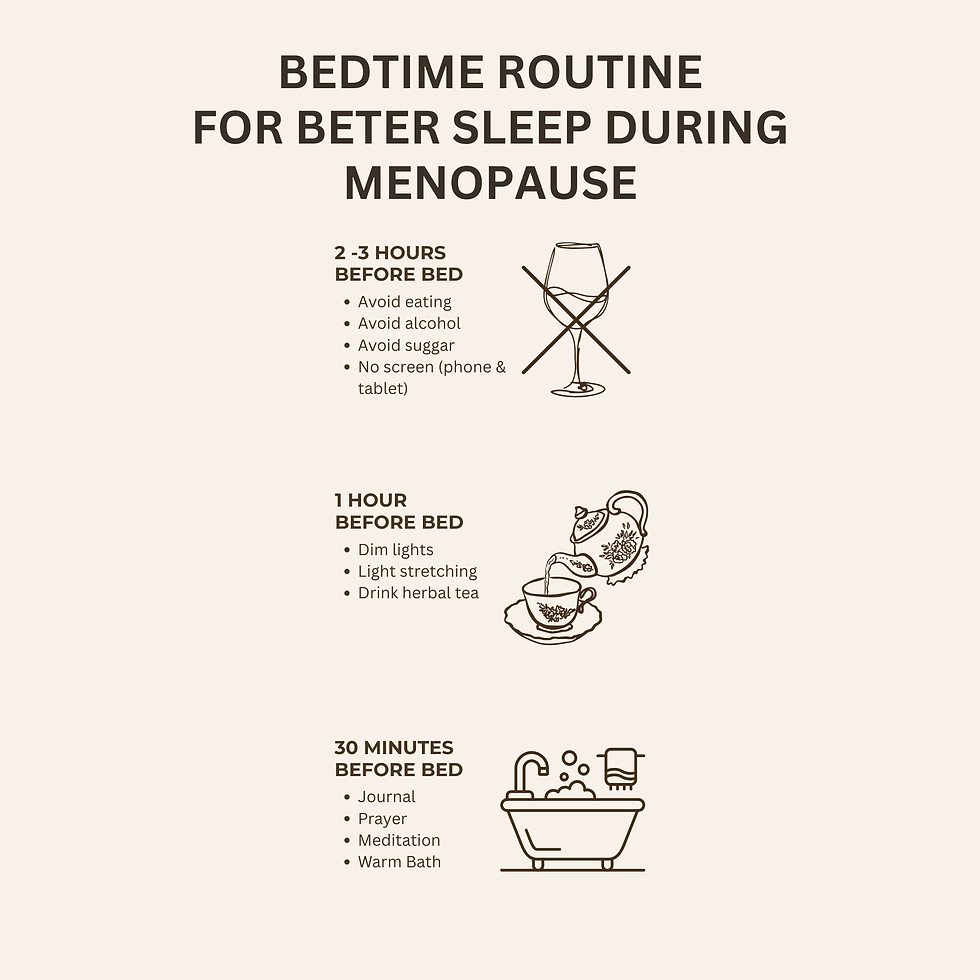
Time Before Bed | What to Do |
2–3 hours before | Finish dinner; avoid heavy sugar and alcohol |
1–2 hours before | Dim lights; step away from work and stressful content |
1 hour before | Light stretching or gentle movement |
30 minutes before | Something genuinely calming — reading, journaling, a warm bath |
Bedtime | Cool, dark room; same time every night |
Consistency matters far more than perfection here. Even doing this four or five nights a week will start to train your nervous system to expect rest at a certain time.
Best Exercises for Better Sleep During Menopause
Movement is one of the best things you can do for menopausal sleep - but the type and timing matter. The goal isn't to push harder; it's to calm your nervous system, not keep it revved up.
Best options for supporting sleep:
Walking (especially outdoors, earlier in the day)
Pilates
Gentle yoga or yin yoga
Light resistance or strength training
Swimming
What to avoid - especially close to bedtime:
High-intensity interval training (HIIT) in the evening
Overtraining or training through exhaustion
Anything that leaves you feeling wired rather than pleasantly tired
If you're currently doing intense workouts and sleeping terribly, it's worth experimenting with reducing intensity for a few weeks and seeing what happens. A lot of women are genuinely surprised by the difference.
When to Consider HRT or Medical Help
If you've been working on lifestyle changes for a while and your sleep is still consistently poor - to the point where it's affecting your energy, your mood, your work, your relationships - it's worth talking to a doctor about more direct support.
Hormone therapy (HRT) can make a real difference for some women, particularly when symptoms feel overwhelming or have been going on for a long time.
By helping to restore more stable hormone levels, HRT may support more consistent sleep, reduce night sweats and the wakeups that come with them, and improve overall quality of rest.
It's not right for everyone, but it's a legitimate option to understand and explore with your provider - not something to dismiss or feel nervous about asking about.
Also worth knowing about:
Cognitive Behavioral Therapy for Insomnia (CBT-I)(5): This is actually considered the gold-standard first-line treatment for chronic insomnia - more effective long-term than sleep medications for many people. It's worth asking your doctor about.
Sleep assessments: If you snore, stop breathing during sleep, or have never woken feeling truly rested, a sleep study can rule out sleep apnea, which is underdiagnosed in women.
Always talk to your healthcare provider before starting hormone therapy or any new supplement protocol.
Always consult healthcare provider before starting hormone therapy
Final Thoughts: You’re Not Broken
Waking up at 3 AM night after night is exhausting in a way that's hard to explain to someone who hasn't lived it. It wears you down physically, mentally, emotionally. And after enough weeks of it, it's very easy to start wondering what's wrong with you.
But nothing is wrong with you.
Your body is going through a real, biological shift. It's not failing - it's adjusting.
And while it might feel like you're stuck in this right now, it's not permanent, and it's not something you just have to white-knuckle your way through.
When you understand what's actually happening - the hormonal shifts, the cortisol patterns, the blood sugar piece - something genuinely changes. You stop blaming yourself. You stop throwing random things at the wall. You start making targeted changes that actually support what your body needs right now.
And things start to improve. Not overnight. But steadily, in a way that lasts.
You're not broken. You're adjusting. And you can absolutely find your way back to sleep.
FAQ
Why do I wake up at 3 AM during menopause?
Usually it's a combination of hormonal shifts, a cortisol spike that comes on too early, and blood sugar drops overnight that trigger your body's stress response — all pulling you out of sleep at the same time.
Is menopause insomnia permanent?
No. With the right lifestyle changes and support — and sometimes with medical help — sleep genuinely does improve. Most women see real change once they understand what's driving it.
Should I take melatonin?
Low-dose melatonin may help short-term, particularly with falling asleep. But it works best as part of a broader approach - not as a standalone fix for the underlying hormonal patterns.
Always consult with your healthcare provider before starting melatonin treatment.
Does exercise help or worsen menopause insomnia?
The right kind absolutely helps. Gentle, consistent movement supports better sleep. Overtraining or doing intense workouts in the evening can make insomnia worse by keeping cortisol elevated.
Can diet affect menopause sleep?
More than most people realize. Blood sugar balance is a big factor - skipping meals, undereating, or having a high-sugar evening can trigger the overnight cortisol spikes that wake you up at 3 AM.
References
About the Author

Sandra is a Certified Menopause Health Coach, Certified Barre® and Pilates Instructor, and has been navigating menopause since her mid-40s.
That lived experience - combined with research-informed training - is the foundation of everything she shares at The Refined Fit.
This space is for women over 50 who want clear, grounded guidance for this stage of life. Strength, metabolism, sleep, mental clarity - without the extremes.
Menopause doesn't require more force. It requires a better strategy.
All content is educational and not a substitute for medical care.


Comments